The category

What is a Capability Platform?

Where capability is built and proven.

A Capability Platform is where capability is built in role-realistic work, and proven by evidence anyone can trust.


Organisations spend over $360 billion a year on training and hiring, yet cannot answer the only question that matters: can this person actually do the job? Courses measure completion. Interviews reward people who interview well. A Capability Platform exists to answer the real question — with evidence.

The category, defined

The three claims that define the category.


A platform earns the name only by honouring all three:

1 · Build capability.

People become measurably better at the work their role requires — not at remembering content, but at performing in real situations. Development, not just testing.

2 · Measure capability defensibly.

Every score is backed by behavioural evidence from role-realistic work. A manager, recruiter, dean, or board can audit the basis for any result. No black boxes.

3 · Close the gap between skill and role.

Not just what someone knows — what they're ready for. Gap to a target role, fit against a real job, practice that closes the specific gaps that matter.
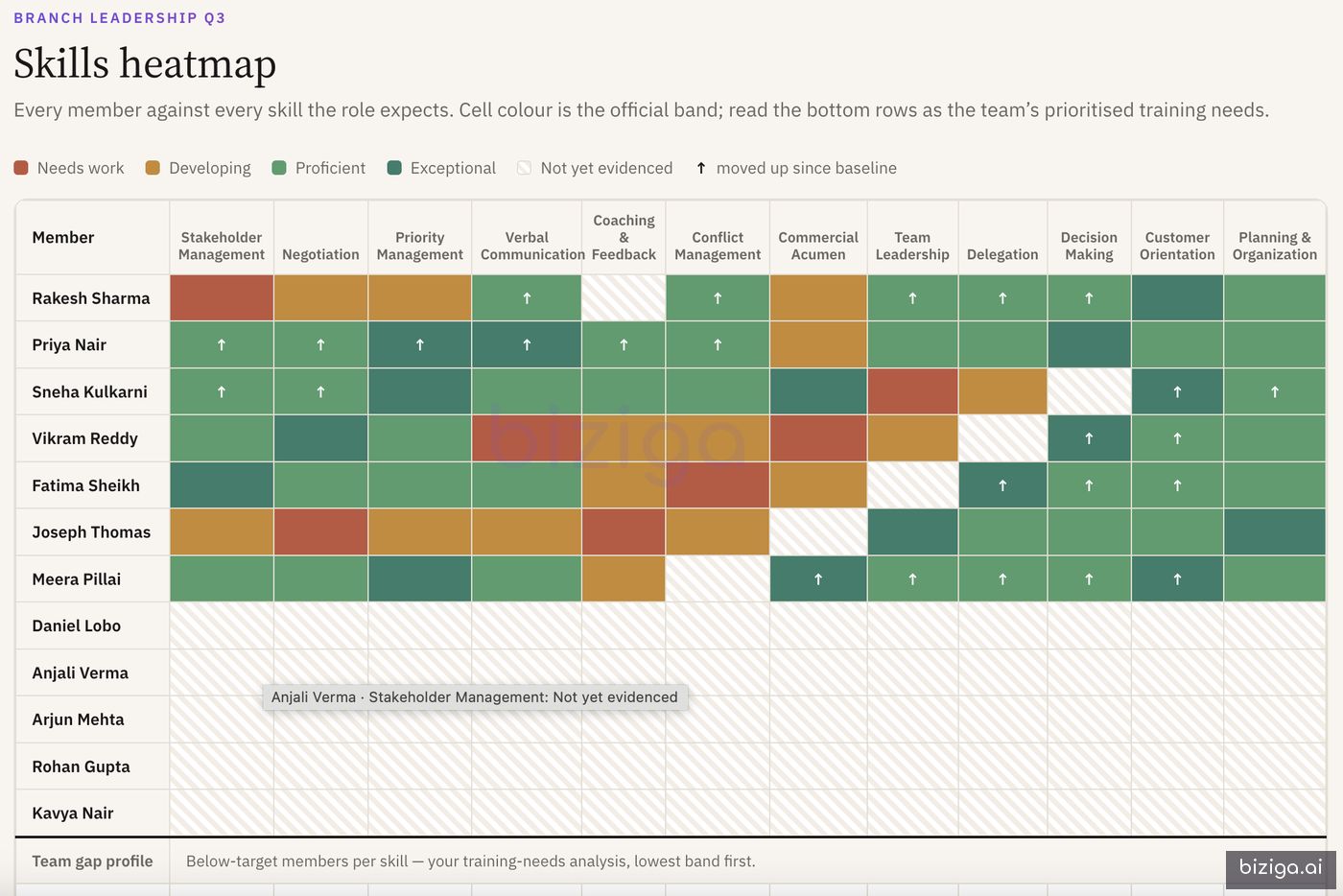
A cohort skills heatmap by band
Claim 2 in practice — capability measured defensibly, auditable by band across a cohort.

And all three at scale. Practice at scale, development at scale, assessment at scale — from one standard. That is what was never possible before AI collapsed the economics of judgment, and it is the whole point of the category.

The distinction that names the category

Skill vs capability.


A skill is the ability to do a specific thing well (negotiate, listen, analyse) — discrete and measurable. A capability is the proven ability to perform in a real role, drawing on many skills plus judgment and context. A Capability Platform deliberately operates at both levels: it measures at the skill level, because that is where rigorous evidence is possible, and reports at the capability level — readiness, role-fit, gap-to-role — because that is what humans make decisions on.

Against the categories it isn't

A Capability Platform is none of these.


Category Optimises for The question it answers
LMS Content delivery & completion Did they take the course?
LXP Content discovery & experience Did they engage with learning?
Assessment vendor Testing & scoring What do they know right now?
AI roleplay tools Conversation practice Can they talk about it?
Capability Platform Building AND proving performance Can they do the job — and can we prove it?

How Biziga delivers the category

One promise. Two named assets.


Biziga is the Capability Platform, and the promise on its logo — AI Powered. Human Focused. — is engineered into the product as two named assets.

The Medha Engine is AI Powered. Biziga's proprietary AI engine — medha is Sanskrit for intelligence — builds complete working worlds: believable stakeholders with agendas and moods, files, inboxes, live voice calls, meetings, deadlines. Every performance is scored against a modern skills taxonomy of 43 skills across 8 categories, behaviourally anchored (BARS) — the same methodology assessment centres use, applied by AI with none of the assessor drift. Assessment-centre rigor at digital scale.

Mira is Human Focused. Feedback is information; coaching is transformation. Mira is the coach in the room with every learner — present through the work, debriefing with the learner's own verbatim words as evidence, always warm, never moving the standard.

Medha does the world and the evidence; Mira does the relationship and the growth. That pairing is what separates a Capability Platform from another AI tool.

FAQ

Straight answers.


Is this an LMS?

No. No course catalog, no completion-as-the-goal. A Capability Platform measures performance, not consumption.

Is this an assessment vendor?

No. Assessment is a mode of the product; development and measurement run in one loop — practise, evidence, close the gap, certify.

How are scores kept fair?

Scores come from a pre-defined, tier-calibrated standard applied identically to everyone — not from an LLM's opinion. The AI applies the standard; it never invents it.

Who is it for?

Corporates (onboarding, manager readiness, succession, sales effectiveness, transformation rehearsal), universities (placement readiness with evidence recruiters trust), and professionals preparing for what's next.

See a capability map, a verbatim-grounded debrief, and a cohort heatmap — live.


Book a demo →